
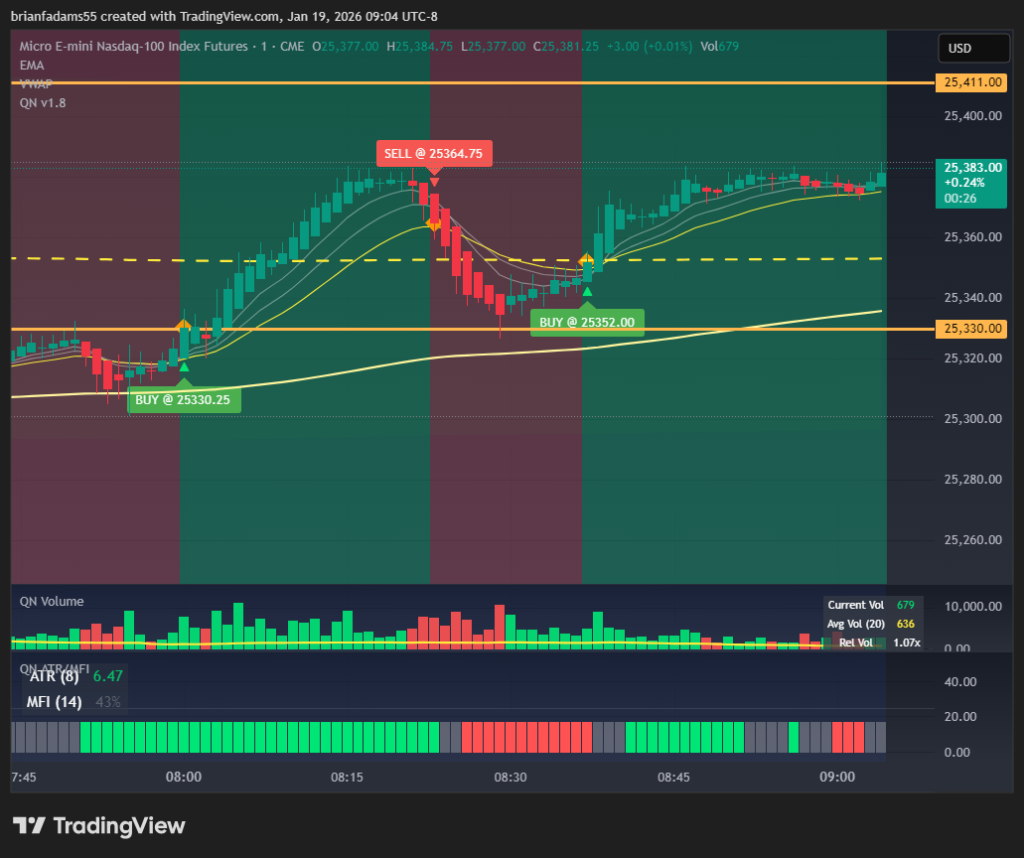
If you’re searching for a tradingview nq scalping indicator, you’re probably not looking for another pretty line on a chart. You’re looking for one thing – a cleaner decision process in a market that moves fast, punishes hesitation, and exposes every weak habit you have.
That is exactly why most traders fail with NQ scalping. Not because they lack indicators. Because they stack too many of them, wait too long, second-guess good entries, and take bad ones when the market speeds up. The Nasdaq does not reward confusion. It rewards structure.
What a TradingView NQ scalping indicator should actually do
A lot of traders start with the wrong question. They ask which indicator is most accurate. That sounds reasonable, but it leads them straight into the weeds. No indicator is going to predict every push, catch every reversal, or hand you easy money on a silver platter.
A good NQ scalping indicator on TradingView should do three things well. It should help identify a high-probability entry area, define risk quickly, and support fast decision-making without clutter. If it cannot do all three, it is decoration.
That matters more on NQ than almost anywhere else. This market can move hard in seconds, retrace just enough to shake traders out, then continue without them. If your tool forces you to interpret five conditions before clicking in, you’re already late.
The best setups are usually simple on the surface. Price reaches an area that matters, momentum confirms, and the trade either works quickly or proves you wrong fast. That’s the standard. Anything slower tends to turn a scalp into a stressful hold.
Why most TradingView indicators fail NQ scalpers
Most indicators were not built for scalpers trying to pull clean moves from a fast index future. They were built for general charting, broad trend analysis, or slower swing decisions. That creates a mismatch.
Lag is the first problem. By the time a typical moving average crossover confirms a move on NQ, the cleanest part of the trade is often gone. Oscillators have the same issue. They can help with context, but if you’re using them as your primary trigger in a fast market, you’re often reacting after the edge has already passed.
The second problem is noise. NQ breathes aggressively. It overshoots levels, snaps back, and creates fake urgency all day long. Indicators that fire too often train traders to overtrade. That is a brutal habit, especially for prop firm traders who cannot afford sloppy losses and unnecessary drawdown.
The third problem is discretion overload. Traders say they want flexibility, but what they usually need is fewer decisions. If your tradingview nq scalping indicator gives signals that still require heavy interpretation, you’re right back where you started – staring at the chart, hoping your read is better than your fear.
The features that separate a useful NQ scalping tool from chart noise
A real scalping tool has to respect speed. That means visual clarity matters. You should be able to glance at the chart and know whether the setup is valid, where your stop belongs, and where first target makes sense.
It also needs logic behind the signal. A random arrow is useless. A structured signal tied to price behavior, momentum, and key reaction zones is different. Now the indicator is not just calling out movement. It is helping you trade a repeatable pattern.
Risk framing is the part too many traders ignore. If the tool helps with entries but leaves stops vague, it is incomplete. Good scalping on NQ depends on being wrong small. Tight, logical invalidation points matter just as much as finding the entry itself.
Profit targeting matters too, but not in the fantasy-trader sense. You do not need huge runners on every trade. Scalpers need realistic target logic that fits the session, the volatility, and the actual structure of the move. If the indicator pushes traders to hold too long, it can be just as damaging as one that gets them in too late.
Best tradingview nq scalping indicator setups are rules-based
This is where traders need to drop the nonsense and noise. The best indicator is not the one with the flashiest visuals. It is the one that supports a rules-based process you can follow under pressure.
That means your setup should answer a few questions before the trade even triggers. Is the market trending or rotating? Is price interacting with a level that matters? Is momentum confirming the move or fading into it? Where is the stop if the setup fails immediately? If those answers are not clear, you do not have a setup. You have a guess.
Rules-based does not mean mechanical in every market condition. NQ still requires judgment. But there is a big difference between using judgment inside a defined framework and making it up as you go. One creates consistency. The other creates emotional chaos.
This is exactly why traders who bounce from indicators stay stuck. They keep changing tools instead of tightening process. One week it is RSI. Next week it is MACD. Then VWAP. Then order blocks. Then something with AI slapped on the label. Same chart addiction, same lack of structure.
A serious tradingview nq scalping indicator should reduce that churn. It should narrow your focus, not expand your confusion.
How to judge signal quality on TradingView
You do not need a long checklist. You need honesty.
Start with signal frequency. If the indicator marks opportunities constantly, that is not a gift. That is temptation. NQ offers enough movement without turning every pullback into a trade idea. Fewer, cleaner signals usually produce better behavior.
Then look at signal location. Great signals tend to appear where a move makes sense, not in the middle of random chop. If the indicator performs best only after obvious hindsight analysis, it is not helping in real time.
Next, watch what happens after entry. A strong scalp signal on NQ should usually work fairly quickly. It does not need to hit target in seconds, but it should show intention. If price stalls, chops, and forces you to babysit every tick, the setup may not have true edge for scalping.
Finally, test whether the tool improves your execution. That is the real standard. Not whether a screenshot looks impressive. Not whether one session produced a monster move. Does it help you take better trades, cut losers faster, and stay out of garbage conditions? If yes, now you are getting somewhere.
Why simplicity beats complexity for NQ scalpers
Scalping is not the place for intellectual theater. You do not win because your chart looks advanced. You win because you can read a setup fast and execute it without freezing.
Simple tools have another advantage. They are easier to trust. When a trader understands why a signal appears, they are more likely to follow the plan. That matters when the market starts moving and emotions spike.
Complex systems often break down in live conditions because they create hesitation. One condition is met, another is close, a third is mixed, and the trader waits. On NQ, that delay is expensive. The move goes, then they chase, then they get trapped. Same story, different day.
This is why brands like Quantum Navigator focus so heavily on structure inside TradingView. The goal is not to impress you with complexity. The goal is to help you stop bouncing from indicators and start executing a cleaner process with defined entries, stops, and targets.
The trade-off every NQ scalper needs to accept
Let’s be blunt. No indicator solves discipline.
Even the best one can only frame the opportunity. You still have to follow the signal, respect the stop, and avoid forcing trades when the market is dead or sloppy. If you want a tool that removes all uncertainty, you are chasing fiction.
There is also a trade-off between sensitivity and selectivity. A more sensitive indicator may catch early moves, but it will usually create more false starts. A more selective one may filter out junk, but you will miss some fast trades. That is normal. The right balance depends on your style, your risk tolerance, and whether you value frequency or cleaner confirmations.
For prop traders, the answer usually leans toward selectivity. Lower drawdown and tighter execution matter more than constant action. For aggressive independents, a slightly faster trigger may fit better, but only if the risk model stays tight.
That is the part many traders skip. They want a better signal without building a better process around it.
What to do next if you’re serious about NQ scalping
Stop looking for magic. Start looking for structure.
The right TradingView indicator for NQ scalping should simplify your chart, tighten your decisions, and help you act with more confidence when the setup appears. It should not turn your screen into a science project. It should not make you guess where risk belongs. And it definitely should not encourage random trades just because price is moving.
If a tool helps you see the setup, define the stop, map the target, and stay disciplined, that is useful. If it also fits the way you actually trade on TradingView, even better. You can see that kind of approach at https://qntrader.com.
NQ is fast, unforgiving, and full of traps for traders who keep searching for the next shiny thing. The edge is usually not hidden. It is built by getting clear, getting structured, and finally trading one solid process well.