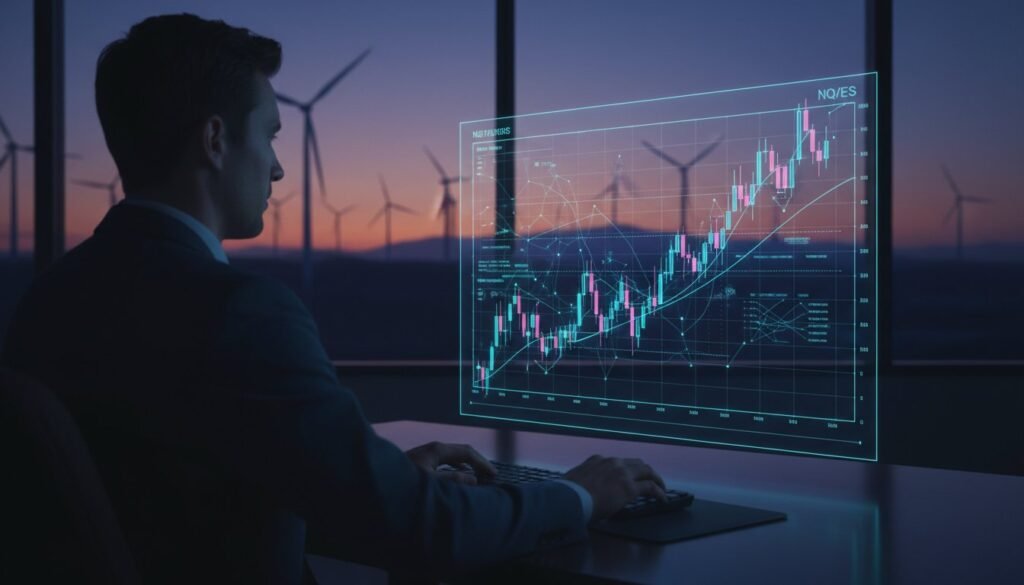
Most futures traders do not need more indicators. They need fewer decisions. That is why ai for day trading futures gets so much attention from NQ and ES traders who are tired of second-guessing entries, moving stops, and watching clean setups turn into emotional trades.
The real appeal is not magic. It is structure. Good AI in futures trading does not replace judgment or print money on command. It reduces decision friction. It helps traders see the same setup faster, apply the same rules more consistently, and stop bouncing from one random chart tool to the next.
If you are day trading index futures through TradingView, that matters more than hype. Speed matters. Clarity matters. Low drawdown matters. And if you are trading a prop evaluation, one bad impulse trade can wreck a week of solid work.
What AI for day trading futures actually means
A lot of traders hear “AI” and picture a black box that knows the future. That is the wrong frame.
In practice, ai for day trading futures usually means software that helps process chart conditions, identify recurring patterns, and present trade locations in a cleaner, more rules-based way. Sometimes that is an indicator that flags a setup. Sometimes it is a model that weighs momentum, volatility, structure, and trend behavior. Sometimes it is a system that defines likely entry zones, stop placement, and profit targets.
The key point is simple. Useful AI does not remove risk. It organizes information faster than a distracted human staring at five indicators and three timeframes.
That is the edge most retail traders are actually missing. Not secret knowledge. Not a holy grail. Just a repeatable way to read the same market without rewriting the rules every ten minutes.
Why futures day traders are looking at AI now
NQ and ES move fast. If you scalp or day trade them, hesitation is expensive. By the time a discretionary trader talks themselves into a trade, the clean entry is often gone.
That is where AI-based tools can help. They can narrow the decision tree. Instead of asking, “Is this trend strong? Is momentum fading? Is this a pullback or a reversal?” the trader gets a clearer framework for what matters right now.
This is especially valuable for traders who already know the basics but cannot execute with consistency. They understand liquidity, sessions, trend, and support resistance. Yet they still miss entries, chase candles, widen stops, and exit winners too early. The problem is not knowledge. The problem is structure under pressure.
AI works best when it acts like a filter. It strips out chart clutter and points the trader back to predefined conditions. That is how you reduce overtrading and random decision-making.
Where AI helps most in NQ and ES trading
The best use of AI is not constant prediction. It is selective decision support.
On fast products like NQ, AI can help identify moments when momentum and structure align instead of forcing trades in the dead middle of noisy price action. On ES, it can help traders stay patient and wait for cleaner confirmations rather than taking every tiny move off the open.
This becomes even more useful when the software is built around practical trading decisions. Entry location. Stop placement. Profit target logic. Session behavior. High-probability setups. Traders do not need more theory in the middle of a live market. They need to know what to do next.
That is why rules-based AI tools tend to be more useful than vague signal services. A signal without context creates dependence. A structured system creates better execution.
What AI cannot do for you
Let us drop the nonsense and noise. AI will not save a trader who ignores risk.
It will not fix revenge trading. It will not make a poor market environment suddenly tradable. It will not turn random clicking into a business. And it definitely will not remove losing trades.
There is also a major trade-off traders need to understand. The more automated a tool becomes, the easier it is for users to stop thinking altogether. That creates a different kind of weakness. If you do not understand what conditions your setup needs, you will panic the moment the market behaves differently.
So yes, use AI to simplify. Do not use it as an excuse to avoid discipline.
The strongest traders use AI as a framework, not a crutch. They know why they are in the trade, where they are wrong, and what invalidates the setup. The software speeds that process up. It does not replace it.
How to judge AI for day trading futures
Most traders get this backward. They ask whether the tool is advanced. The better question is whether the tool makes execution simpler.
If an AI indicator or strategy gives you ten conditions, five colors, and three conflicting alerts, it is not solving your problem. It is adding another layer of confusion.
Look for tools that answer basic trading questions clearly. Is there a setup here or not? Where is the entry? Where does the stop belong? Where is the first logical target? Is this built for the markets you actually trade, like NQ and ES, or is it generic software pretending to work everywhere?
Compatibility matters too. If you live on TradingView, then a tool built specifically for that environment is far more useful than a system that forces you into clunky workarounds.
And be honest about your own goal. Some traders want full automation because they hate decision-making. Others want support that sharpens discretionary execution without taking control away. Neither approach is automatically better. It depends on your skill level, your temperament, and your risk limits.
For most retail futures traders, the sweet spot is simple. Use AI to standardize setup recognition and risk placement, then execute with discipline.
The real edge is lower drawdown and cleaner execution
This is where the conversation gets practical.
A lot of traders chase AI because they think it will help them hit home runs. But for day trading futures, the bigger win is often avoiding stupid losses. Fewer bad entries. Fewer late entries. Fewer trades taken in chop. Fewer oversized losses from moving stops.
That matters even more for prop traders. Evaluations are not usually failed because a trader lacks market knowledge. They fail because the trader breaks process. They force trades, exceed drawdown limits, or lose control after one red position.
An AI-supported workflow can help fix that by making execution more mechanical. When the setup is predefined, the stop is planned, and the target is mapped, the trader has less room to improvise badly.
That is not sexy marketing. It is just how consistency is built.
What a smart workflow looks like
A smart futures workflow is boring in the best way.
Before the session starts, the trader knows which market they are focused on, what type of setup they want, and what conditions they will ignore. During the session, the software helps flag valid areas or patterns. The trader then follows the rules instead of negotiating with every candle. After the trade, results are reviewed based on execution quality, not fantasy outcomes.
That is where AI becomes valuable. It compresses the path from analysis to action.
Used properly, it can help traders stop bouncing from indicators and start building one repeatable process. That is the difference between looking busy and trading professionally.
For traders who want a more structured TradingView-based approach, Quantum Navigator positions its tools around exactly that problem – clear entries, defined stops, profit targets, and less guesswork on NQ and ES.
Should you use AI for your futures trading?
If you are still learning basic market structure, AI can help, but only if it teaches you discipline instead of dependency.
If you already understand futures and just need cleaner execution, AI may be one of the fastest ways to remove noise from your chart and tighten your process.
If you are expecting perfect predictions, save your money. That is fantasy. But if you want a way to trade with more consistency, more structure, and less emotional drift, AI is worth serious attention.
The futures market does not reward people for collecting tools. It rewards traders who can see a setup, trust the plan, and manage risk without flinching. If AI helps you do that faster and with less confusion, then it is not a gimmick. It is a practical edge.