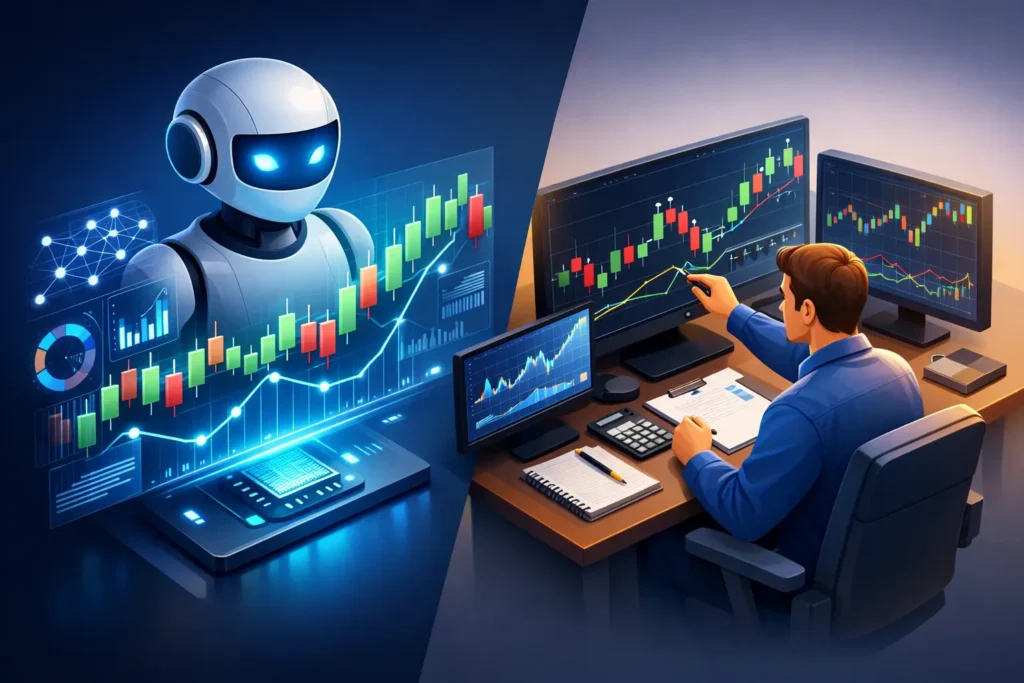
Most traders do not need more indicators. They need fewer decisions.
If you trade NQ or ES long enough, you hit the same wall. One indicator says buy, another says wait, price spikes into your stop, then runs without you. You change settings, add more tools, watch more videos, and somehow end up less clear than when you started. That is exactly why the search for an ai futures trading indicator has exploded.
Not because traders want magic. Because they want structure.
What an AI futures trading indicator should actually do
Drop the nonsense and noise for a minute. A real AI futures trading indicator is not valuable because it sounds advanced. It is valuable if it helps you make faster, cleaner decisions in live market conditions.
That means it should do three things well. First, it should reduce chart clutter instead of adding to it. Second, it should help define entries, stops, and targets with consistency. Third, it should fit the speed of futures trading, especially if you are scalping or day trading the NQ and ES.
If your tool gives you a pretty signal but leaves you guessing where risk belongs, it is incomplete. If it gives you ten conditions before you can take a trade, it is too slow. If it works great in screenshots but falls apart during fast opens, it is not helping.
The best tools do not make you feel smarter. They make your process simpler.
Why traders are moving toward AI-based signals
Retail futures traders are tired of bouncing from indicators. That is the truth. They have tried moving averages, oscillators, volume tools, support and resistance scripts, order flow add-ons, and whatever the latest social media trader is selling this month.
The problem is rarely effort. The problem is fragmented decision-making.
AI-based indicators appeal to traders because they promise to organize market inputs into a cleaner signal. Instead of staring at five separate tools and trying to interpret them under pressure, traders want a system that does more of the sorting for them. That matters even more in prop firm environments where a sloppy entry can wreck a day and a bad stop can wreck an evaluation.
There is also a psychological benefit. Rules reduce hesitation. When the chart gives you a defined setup, with a clear invalidation point and a logical target zone, execution gets easier. Not easy. Easier.
That difference matters.
The biggest lie in this market
Here is the lie: AI can predict every move.
It cannot.
An ai futures trading indicator is still operating inside probabilities. Market structure still changes. Volatility still expands and contracts. News events still distort price. A tool can improve your read on the market, but it does not remove uncertainty.
That is not a weakness. That is just trading.
The smarter way to think about AI is this: it can help you filter lower-quality setups, react faster to repeatable patterns, and trade with less emotion. That is already a major edge if you have been overtrading, entering late, or moving stops because you lack a clear framework.
So yes, AI can help. No, it is not a shortcut around discipline.
What to look for in an ai futures trading indicator
If you trade on TradingView, especially in fast markets, your indicator needs to be practical before it is impressive.
Start with signal clarity. You should be able to glance at the chart and know whether there is a valid setup or not. If the indicator needs a long explanation every time it prints something, it is creating friction.
Next is risk structure. Good signals tell you more than direction. They help define where the trade fails. For futures traders, that is not optional. Tight risk is the entire game, particularly for prop traders trying to keep drawdowns under control.
Then look at market fit. NQ and ES do not move the same way. NQ is faster, sharper, and less forgiving. ES can be cleaner but still punishes weak timing. An indicator that claims to work on everything often ends up being mediocre on the two markets you actually care about.
You also want a workflow, not just a signal. The strongest tools support a full decision chain: setup appears, entry triggers, stop is placed, target is planned, trade is managed. That is where consistency starts to show up.
Why simplicity beats complexity in futures trading
A lot of traders still think more complexity means more precision. Usually it means more hesitation.
When price is moving quickly, you do not have time to debate six conflicting readings. You need a structured read, a defined action, and enough confidence to execute without second-guessing every tick.
That is why the strongest indicator setups are usually visually clean. They are built around repeatable behavior, not endless interpretation. This is especially true for scalpers. If your chart setup slows your decision-making, it is costing you money even before the trade begins.
Simple does not mean weak. It means usable.
And in live futures trading, usable beats clever every time.
Where most traders misuse AI indicators
The biggest mistake is treating the indicator like a substitute for a trading plan.
A signal is not a business model. If you ignore session conditions, trade directly into major resistance, size too large, or revenge trade after a stop-out, no indicator is going to save you. Traders who get the best results from AI tools use them inside a rules-based process.
The second mistake is constant switching. Traders buy one tool, use it for three days, take two losses, and then go hunting for the next miracle. That cycle destroys consistency because you never stay with one method long enough to understand its strengths and limitations.
The third mistake is expecting every signal to be tradable for every trader. Some setups fit scalpers. Others fit patient intraday traders. Some are stronger in trend conditions. Others work better in rotational periods. It depends on how you trade and how disciplined you are with risk.
The TradingView advantage
For retail traders, TradingView matters because speed and clarity matter. If your entire workflow lives on one charting platform, execution gets more organized. You are not juggling disconnected tools and trying to stitch together a plan during the session.
That is one reason traders are increasingly looking for AI tools built specifically for TradingView. Familiar charts reduce friction. Visual signals are easier to follow. Setup recognition gets faster.
A strong TradingView-based indicator also makes review easier after the session. You can go back, mark the valid setups, compare your entries, and see whether you followed the rules or traded emotion. That feedback loop is where improvement starts becoming measurable instead of vague.
What disciplined traders really want
They do not want more theory. They want a repeatable edge they can actually execute.
That means clear entries. Clear stops. Clear targets. Fewer impulsive decisions. Lower drawdowns. More consistency over a series of trades instead of one lucky screenshot posted online.
This is where a structured product ecosystem can make a difference. When an indicator is paired with a strategy, training, and chart-based examples, traders stop guessing how to use it. They can follow a process instead of inventing one in real time. That is the real value. Not hype. Not magic. Structure.
For traders focused on NQ and ES through TradingView, that kind of system is far more useful than another generic tool with flashy marketing. If you want fewer moving parts and more decisive execution, that is the direction to take. Quantum Navigator is built around exactly that idea – stop bouncing from indicators and start trading a rules-based process you can repeat.
So is an AI futures trading indicator worth it?
Yes, if it cuts confusion and improves execution.
No, if you are buying it because you want certainty.
That is the trade-off. The right tool can help you act with more discipline, spot higher-probability setups, and stay inside defined risk. But the trader still has to follow the plan. You still have to respect the stop. You still have to avoid forcing trades when the market is not offering your setup.
If you approach AI the right way, it becomes a decision filter. That is powerful. It can keep you out of junk trades and get you into cleaner ones. For a futures trader, that alone can change the curve of your results.
Stop searching for a miracle and start looking for a system you can trust under pressure. That is where real progress begins.